

Spiritual and psychic websites are unique in that they exist in a niche where context is deeply personal. Readers often search for answers about relationships, purpose, grief, or even direction for their lives. Due to these topics, Google evaluates this type of website more carefully than a typical blog.
Even if the site is tarot-focused or leans more toward astrology and intuitive guidance, it can still influence the decisions people make in meaningful ways. This places spiritual content close to what Google considers high-impact topics.
What this means for creators is that success in this niche is not only about the rankings. It is about trust, clarity, and responsibility.
How Google Evaluates Spiritual and Psychic Content
YMYL and Trust Signals Explained
Google groups specific topics under higher levels of scrutiny because they can affect real-life outcomes. Spiritual content often overlaps with highly emotional decision-making, which brings it closer to this category.
To perform well, content requires:
- Clear intent
- Honest tone
- Balanced explanations
- Transparency about what is opinion vs interpretation
Google’s guidance on people-first content highlights how usefulness and authenticity are key:
https://developers.google.com/search/docs/fundamentals/creating-helpful-content
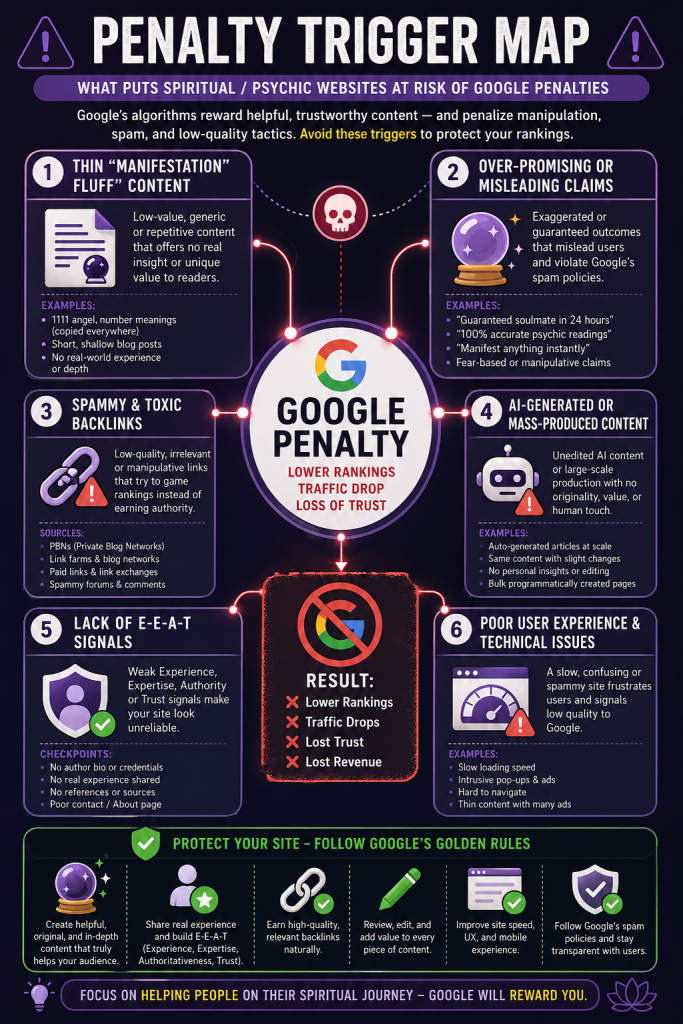
The Role of E-E-A-T in Spiritual Content
E-E-A-T stands for Experience, Expertise, Authoritativeness, and Trustworthiness.
In the various spiritual niches, experience plays a vital role. A reader is more likely to trust content that feels grounded in real understanding instead of some abstract theory.
This could include:
- Real reading scenarios
- Personal interpretations
- Observations based on client patterns
The more human the content comes across, the stronger the trust signal for readers.
Common Google Penalties in Spiritual Niches
Thin Content and Repetitive Topics
Multiple sites publish dozens of similar articles, all based on the same idea. Over time, this creates duplication.
For example:
- Multiple pages explaining identical tarot meanings
- Repetitive “signs” articles with little variation
Google may start reducing visibility when content starts to lack uniqueness.
Misleading Claims and Overpromising
Statements that suggest guaranteed outcomes can further create credibility issues.
Content that performs better will typically:
- Acknowledges uncertainty
- Presents possibilities rather than promises
- Avoids absolute language
Spammy Backlinks and Affiliate Abuse
Backlink manipulation is still one of the fastest ways to trigger a penalty.
Some of the common risks include:
- Purchasing links from unrelated sites
- Overusing keyword-rich anchor text
- Linking only for the purpose of ranking
AI Content Without Human Value
AI tools are commonly used, but content still needs an original, humanistic feel.
If an article lacks depth, emotional awareness, or even a few unique ideas, it is simple for systems to deprioritize it.
Real Case Study 1: Tarot Blog Hit by Helpful Content Update
What Happened
A tarot-focused blog that published daily readings suffered from a sharp drop in visibility after a major update.
What Went Wrong
The site relied on templates. This meant that each post followed the same structure, and the interpretations were reused across multiple articles.
There was very little distinction between pages.
How It Recovered
The site had to shift its strategy:
- Added real-life examples from readings
- Expanded explanations with emotional context
- Lowered publishing frequency
Over time, the rankings stabilized as the content quality also improved.
Real Case Study 2: Psychic Affiliate Site Penalized for Links
What Happened
A comparison site that targeted keywords like “best online psychics” lost rankings shortly after a link-focused update.
The SEO Mistake
The site had:
- A high volume of low-quality backlinks
- Repetitive anchor texts
- Aggressive affiliate placement without context
Recovery Strategy
The recovery process included:
- The removal of harmful links
- Rewriting content to come across more balanced
- Reducing overly promotional sections
It further began to focus on clearer comparisons with more user value.
Some creators in this space now use structured affiliate strategies, such as PsychicOz Affiliate (https://affiliates.psychicoz.com), while keeping recommendations naturally integrated into helpful content.
Real Case Study 3: Astrology Site Losing Trust Signals
What Happened
An astrology site started a gradual decline in search visibility that continued for months.
Content Quality Issues
The site lacked:
- Author attribution
- Updated content
- Clear structure
This made it more difficult for search systems to assess credibility.
Fixes That Worked
The site was improved by:
- Adding author profiles
- Updating their existing articles
- Improving formatting and readability
These changes helped restore visibility with time.
Platforms That Survive Updates Better
Why Curated Networks Perform Stronger
Curated platforms tend to maintain a more consistent overall quality. They control who provides services and how information is presented.
This reduces variability while also building trust.
Example: PsychicOz vs Open Marketplaces
PsychicOz follows a curated approach in which advisors are screened and monitored. This creates a more stable experience compared to open marketplaces, where quality may be widely varied.
Other platforms like Keen or Kasambe offer broader access but may suffer from less consistency between advisors.
Consistency is usually a key factor in long-term search stability.
How to Avoid Google Penalties in Spiritual Niches
Content Strategy That Works
- Focuses on depth instead of quantity
- Provides insights that go beyond basic explanations
- Avoids repeating ideas across multiple pages
Ethical Monetization
Affiliate links should be supportive of the content without dominating it. When readers feel they are well informed instead of pushed, trust can grow.
Technical SEO and UX Signals
- Ensures fast loading times
- Optimization for mobile users
- Make navigation a breeze
User experience plays an increasingly important role in how content is evaluated.
New Insight: Emotional Accuracy vs Search Accuracy
One of the most overlooked concepts when it comes to spiritual SEO is emotional accuracy.
Search accuracy answers the question in a direct way.
Emotional accuracy connects with how the reader feels.
Content that recognizes uncertainty while validating emotions and then providing thoughtful guidance will often perform better over time.
This is especially important with topics that involve things like relationships, healing, or personal growth.
Recovery Framework for Penalized Sites
If your site has been affected, focus on rebuilding slowly:
- Audit your content and remove any weak pages
- Clean up harmful backlinks
- Improve your transparency and trust signals
- Expand your content with real insight
- Allow time for recovery
Google’s spam policies provide additional clarity on what to avoid:
https://developers.google.com/search/docs/essentials/spam-policies
Closing Thoughts
Google penalties within the spiritual niches are far from random events. They are signals that something truly needs to improve in how content can serve the reader.
The sites that perform best are those that prioritize clarity, depth, and true honesty.
Spiritual content has the power to influence others in highly meaningful ways. When that responsibility is handled with care, users and the search systems respond in a positive manner.
Frequently Asked Questions
1. What is a Google penalty in a spiritual niche?
A Google penalty happens when a website loses rankings or visibility because Google detects low-quality content, spam tactics, manipulative links, or other violations of its search guidelines.
2. Can psychic, tarot, astrology, or manifestation websites get penalized?
Yes. Spiritual websites can be affected if they publish thin content, use exaggerated claims, buy spammy backlinks, copy content, or create pages only for affiliate clicks instead of helping readers.
3. What are the most common penalty triggers in spiritual niches?
Common triggers include keyword stuffing, copied horoscope content, fake reviews, misleading promises, low-quality AI content, toxic backlinks, doorway pages, and articles that lack real experience or trust signals.
4. Are Google penalties always manual actions?
No. Some penalties are manual actions shown in Google Search Console, while others are algorithmic ranking drops caused by Google updates or quality systems.
5. How can I tell if my spiritual website has been penalized?
Look for sudden drops in organic traffic, lost keyword rankings, fewer indexed pages, or a manual action notice in Google Search Console.
6. What is the difference between a penalty and a Google algorithm update?
A manual penalty is a direct action from Google. An algorithm update is an automated ranking adjustment that may reduce visibility if your site is seen as less helpful or less trustworthy.
7. Can low-quality AI content cause ranking drops?
Yes. AI-assisted content is not automatically bad, but mass-produced, repetitive, unedited, or generic content can hurt rankings if it does not provide original value.
8. Is affiliate content risky for spiritual websites?
Affiliate content is not risky by itself. The risk comes when pages are written only to push clicks, contain little original insight, or make exaggerated claims about psychic accuracy, manifestation, or outcomes.
9. Do backlinks still matter for psychic and spiritual SEO?
Yes, backlinks can help, but quality matters more than quantity. Links from trusted, relevant websites are safer than paid link farms, spam directories, or private blog networks.
10. What are toxic backlinks?
Toxic backlinks are low-quality or manipulative links that appear unnatural. These may come from spam sites, unrelated directories, hacked pages, link farms, or paid backlink schemes.
11. Should I disavow bad backlinks?
Only disavow links when there is a clear pattern of spammy or manipulative backlinks and you cannot remove them. Disavowing without proper review can sometimes do more harm than good.
12. Can exaggerated spiritual claims hurt SEO?
Yes. Claims like “guaranteed soulmate,” “100% accurate reading,” or “manifest anything instantly” can reduce trust and may conflict with Google’s focus on helpful, honest content.
13. Why does E-E-A-T matter in spiritual niches?
E-E-A-T stands for Experience, Expertise, Authoritativeness, and Trust. Spiritual websites benefit from real author insight, transparent policies, helpful explanations, and honest limitations.
14. What trust signals should a psychic affiliate website include?
Useful trust signals include author bios, clear contact information, editorial policies, affiliate disclosures, privacy policies, review methodology, updated content dates, and balanced recommendations.
15. Can copied tarot or horoscope content cause problems?
Yes. Reused or copied spiritual content can make a website look low-value. Original explanations, examples, interpretations, and personal insights make content more useful.
16. How often should spiritual SEO content be updated?
Review important pages every few months, especially comparison pages, affiliate pages, pricing pages, and articles that mention platforms, features, rankings, or current SEO practices.
17. What should I do first after a sudden ranking drop?
Check Google Search Console, review recent Google updates, compare traffic dates, audit backlinks, identify thin pages, and look for technical issues such as indexing errors or slow site speed.
18. Can a site recover from a Google penalty?
Yes. Recovery is possible when the site removes spam tactics, improves weak content, fixes technical problems, cleans up bad links, and rebuilds trust over time.
19. How long does Google penalty recovery take?
Recovery can take weeks or months depending on the cause, site size, cleanup quality, and how quickly Google recrawls and reassesses the website.
20. What is the safest SEO strategy for spiritual affiliate websites?
The safest strategy is to create original, helpful, transparent content that answers real reader questions, avoids manipulative claims, earns links naturally, and recommends services honestly.