

Why manifestation moved from the margins to the mainstream
While manifestation did not originate on Instagram, what has clearly shifted is how openly people are engaging with the topic. What was once confined to a journal, spiritual workshop, or early morning routine has now been boiled down into 30-second video reels.
Rather, the shift is that on Instagram, the current manifestation trend has become more about telling the story of the inner self than about making bold declarations to the universe. Users are no longer simply declaring what they want. Instead, they are sharing what it feels like to want something, to hope for something, to wait for something, to doubt oneself, etc. This is why the trend transcends spirituality.
To some, manifestation is belief. For others, it is language. It is a way to discuss goals, emotions, and uncertainty without appearing clinical or transactional. Even skeptics consume content about it because it provides order in places that don’t otherwise have it.
Understanding what’s trending on Instagram is relevant because it tells us what the whole world is thinking. It’s telling us how the world is managing the challenges of the economy, burnout, relationship stability, and identity issues. Manifestation trends are about more than desire. They are about agency.
This article examines the manifestation techniques currently gaining traction on Instagram, why they resonate, and what they reveal about how people seek meaning, reassurance, and direction in a rapidly changing world.
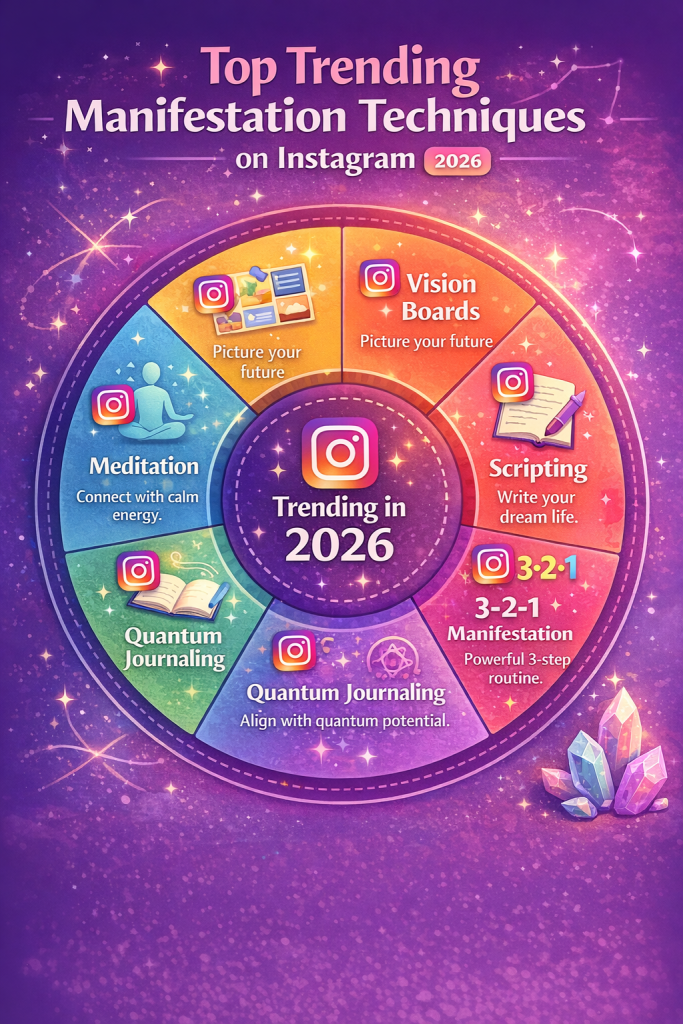
The Evolution of Manifestation on Instagram
From vision boards to everyday rituals
The content of early manifestation on Instagram was heavily visual-centric in terms of outcome. There were a great deal of vision boards, luxury-inspired images, and affirmations written in gold lettering. The theme was aspirational and somewhat external: money, success, romance, status.
Over the years, that tone started to feel out of sync with the world. As the financial and emotional stakes grew, viewers became wary of content that promised success with little work or explanation. Though manifestation wasn’t going away anywhere, it was evolving.
Today’s trending content doesn’t so much emphasize what one wants to acquire as focus on what one wants to be. Tranquil mornings, clear distinctions, and emotional stability characterize today’s visual content, speech, and aspirations.
How manifestation language changed
Instead of “I am attracting abundance,” creators now say things like:
- “I’m learning to trust timing.”
- “I’m aligning my habits with what I want to feel.”
- “I’m practicing patience without giving up hope.”
This shift matters. It reframes manifestation from an outcome-control approach to self-regulation. That reframing makes the practice accessible to people who don’t identify as spiritual but still crave intention and direction.
Aesthetics as emotional signaling
Instagram is still a visual service, and aesthetics serve as emotional triggers rather than status symbols, with colors such as white and handwriting, or slower loading times and lighting, signifying candor and contemplation.
These visual cues are quietly communicating safety. They are advising the audience that this content doesn’t require belief. It is giving permission for contemplation.
Why Instagram Became the Home of Modern Manifestation
Visual storytelling meets emotional immediacy
Manifestation feeds on imagination, and Instagram is good at visual storytelling. Reels enable people to pair words with visuals, music, and pacing that influence how the user feels within one or two seconds.
Even a single reel may incorporate journaling, breathing exercises, affirmations, and ambiance to provide a holistic experience. For those scrolling these videos late at night or between tasks, this could be crucial.
Repetition and belief formation
Instagram’s algorithm follows a pattern of repetition. Viewers are likely to be exposed to similar language several times in a short span of time, not only among different user content but also among the content of different creators. This helps the concept of manifestation become normalized even for people who do not actively engage in the practice.
From a psychological point of view, this kind of repetition can indeed have an impact on how people perceive things. Seeing repetition of “trust the process” or “don’t attach to the outcome” could actually change people’s narration of their experiences, regardless of their spirituality.
Research from the American Psychological Association shows that visualization and mental rehearsal can influence motivation and behavior by shaping expectation and focus, even without supernatural assumptions. (https://www.apa.org/monitor/2015/03/visualization)
Community validation through interaction
Likes, saves, and shares act as social proof. When users see thousands of people resonating with a manifestation message, it reinforces the idea that these practices address shared emotional needs.
Comment sections usually read like group therapy sessions. People compare interpretations and admit doubts, all while validating each other’s struggles. Manifestation becomes less about belief and more about belonging.
Trending Manifestation Techniques on Instagram Right Now
Some of the most notable changes on Instagram include the shift from labor-intensive manifestation wording. Still, “soft manifestation” does not support that wanting it more is going to make it happen.
But this trend feels particularly relevant within a culture of burnout. There’s a new understanding of manifestation as a regulation of the nervous system instead of being obsessed over desired outcomes.
Example: An artist shares their reel with ways of letting go of the pressure about career goals. Instead of envisioning success, they work on maintaining their body’s fight-or-flight response because that is what they know will more likely be rewarded with clarity of mind than a muddying state of struggle.
Why it matters
Soft manifestation makes it easier for people to get involved. There is no feeling of guilt when the process or results are slow in coming. The practice becomes emotionally sustainable rather than performative.
Writing the future in the past tense
Scripted journaling, often called “future scripting,” has resurfaced with a softer tone. Instead of manifesting luxury or status, creators write about emotional states they want to inhabit.
Common themes include:
- Feeling grounded at work
- Having peaceful conversations
- Trusting personal timing
These reels tend to show slow handwriting, morning light, and reflective captions. The appeal lies in narrative control. Writing a future story helps people feel less overwhelmed by uncertainty.
Example: A reel shows a notebook entry that reads, “I’m grateful I handled that conversation with clarity and calm,” paired with a caption about practicing emotional rehearsal rather than prediction.
Why it matters
This trend combines manifestation with cognitive reframing. It is useful for users as it emphasizes behavior, which is pragmatic even for skeptics.
Identity-based manifestation
Becoming the person, not chasing the result
The other big shift in the trend is the move from outcomes to identity. This means, instead of making the subject create the thing or outcome, the creators describe the process of becoming the person they are, who naturally has those things. Now, this is a trend of actual psychology and habit formation, and a little bit of spirituality.
Example: In one case, the creative says that instead of focusing on finding a relationship, they focused on becoming someone who communicates clearly and respects their needs, and that everything else became secondary.
Why it matters
Identity-based manifestation feels empowering without promising control. It reframes manifestation as self-development, which aligns well with mainstream wellness culture.
Small intentions with low emotional stakes
Huge manifestations can feel intimidating. Micro-manifestation breaks intention-setting into smaller, lower-pressure moments. Common micro-intentions can include:
- A calm meeting
- A productive afternoon
- An honest conversation
These practices feel achievable and reduce fear of failure.
Example: A reel shows a creator setting a single intention for the day: “move through today without rushing.” The comments are filled with viewers sharing similar intentions.
Why it matters
Micro-manifestation builds trust. When intentions feel realistic, belief feels less risky.
Why These Trends Are Gaining Traction Now
Economic uncertainty and emotional fatigue
During periods of instability, interest in practices of meaning-making tends to rise. When it is uncertain whether long-term planning will be effective, one tends to look within oneself. The practice of manifestation allows one to take control of one’s life without requiring complete and total certainty. Unlike the rigid system of self-help, manifestation allows for a degree of variability. One is able to change their expectations while not entirely giving up hope.
Agency without pressure
With modern manifestation trends, choice is stressed over necessity or duty. The viewer is not told that they are not succeeding if manifestation is not achieved in their life. Change inside is noted without manifestation. This is important because it builds shame resilience.
Psychological relief, not guarantees
The type of users who interact with such material is not necessarily with the anticipation of getting results, but with the overall comfort they derive from the practice of the event itself. The practice becomes the benefit sought.
Research from the Pew Research Center shows that many adults blend spiritual ideas with personal interpretation rather than formal doctrine. Manifestation fits this pattern by offering meaning without rigid belief systems. (https://www.pewresearch.org/religion/)
The Psychology Behind Manifestation Content
Visualization and attention bias
Visualization works less like magic and more like a focused form of training. When people repeatedly imagine a certain outcome or certain emotional states, they become more attentive to related opportunities and behaviors. This requires no belief in external forces, but in how attention shapes perception.
Repetition and emotional priming
The algorithm for Instagram reinforces repetition. Seeing similar language across various creators can normalize emotional frameworks. Over time, this can change how people label experiences.
Example: Calling uncertainty “divine timing” instead of “failure” alters emotional response, even if the situation stays the same.
Where intuition fits cognitively
Intuition tends to reflect subconscious pattern recognition. Several manifestation creators describe intuition as noticing subtle signals rather than receiving messages. This framing aligns with how people naturally process complex emotional information.
Where Psychic Perspectives Enter the Conversation
Manifestation versus interpretation
As manifestation content turns into something more grounded, many creators and viewers are quietly acknowledging the limits of the practice. Setting intentions can focus clarity, but it doesn’t always explain why certain patterns repeat or why progress feels stalled despite your consistent effort.
This is where psychic and intuitive frameworks usually enter the conversation. These are not replacements for manifestation, but as interpretive layers. While manifestation emphasizes intention and alignment, psychic perspectives are focused on time and emotional residue. They are also looking at unseen influences that shape how situations unfold.
On Instagram, this shows up when creators say things like:
- “I did everything right, but something still felt blocked.”
- “I let go, but the pattern keeps repeating.”
These statements signal a shift from desire to understanding.
Why insight often matters more than outcomes
Many users are not looking for a guarantee. They want context. Psychic frameworks appeal because they offer narrative explanations when manifestation alone does not feel sufficient. So, instead of asking, “Why hasn’t this happened yet?” people ask, “What am I not seeing?” That question invites interpretation rather than control.”
This mirrors how people use therapy or coaching and how some use reflective writing. The value lies in meaning-making, not prediction.
Contextual Use of Professional Guidance
Personal practice versus guided interpretation
Instagram manifestation trends focus on self-led rituals. However, there are many people who get to a point and continue to feel uncertain as they have guided themselves in rituals and practices, created new habits, and changed their thinking.
During those times, some individuals prefer to enrich their personal practices with guided interpretation, either through a coach, therapist, or an intuitive professional. It’s not about authority, it’s about perspective.
Within this context, structured platforms that connect users with experienced, intuitive practitioners are sometimes referenced as optional resources. For example, some creators note that people who want deeper reflection beyond social media occasionally explore professional readings through established affiliate programs such as the PsychicOz affiliate program at https://affiliates.psychicoz.com, framing it as one of many ways individuals seek clarity rather than as a promised solution.
The distinction matters. Guidance is positioned as support, not dependency.
Why neutrality builds trust
Creators who are willing to mention external resources responsibly can do so without urgency or exclusivity. They will emphasize autonomy and choice. This approach aligns with ethical standards around influence and disclosure, which prioritize transparency over persuasion.
The Federal Trade Commission’s guidance on social media disclosures underscores the importance of clarity and non-misleading communication when referencing affiliate relationships.
(https://www.ftc.gov/business-guidance/resources/disclosures-101-social-media-influencers)
The Role of Influencers in Shaping Beliefs
Influencers as emotional translators
Furthermore, manifestation influencers are not teachers but translators. They put words to abstract emotions like uncertainty or hope.
This role of translation also has influence, regardless of whether such claims are being exercised or not. This is because how we portray our experiences can inevitably affect how people understand their own experiences.
Responsibility without authority
This is especially so since, as manifestation content becomes more mainstream, audiences prove to be critical and prefer creators who recognize such things as nuance, timing, and effort, as opposed to promising outcomes.
Research on parasocial relationships shows that trust increases when creators appear reflective and balanced rather than absolute. (https://journals.sagepub.com/doi/10.1177/1461444820922781)
This is why lots of successful creators openly discuss doubt, setbacks, and patience. Vulnerability, when handled responsibly, reinforces credibility.
Manifestation Myths that Instagram is Quietly Letting Go Of
The decline of instant results
The idea that “thinking makes it so” is quickly losing traction. Viewers are more often skeptical of content that implies immediate results without context. Instead, creators are now discussing timing, effort, and emotional readiness. Manifestation becomes a process instead of a shortcut.
Effort re-enters the conversation
Modern manifestation content acknowledges that intention has to be paired with action. Setting boundaries while building habits and making a few uncomfortable choices are framed as part of alignment. This shift is reflective of a broader cultural move toward realism in wellness content.
The Business of Manifestation Content
Monetization without backlash
There has been general acceptance of monetization as long as it feels well-aligned, and journals, courses, and tools are tolerated as long as they promote reflection and not transformation. The backlash only starts when monetization is said to result in an outcome.
Ethical boundaries
Responsible creators will also avoid setting themselves up as necessary intermediaries. Instead, they invite readers to hold on to a sense of agency, as well as a sense of skepticism, which is like a border.
Does Manifestation Actually Work
What science can explain?
From a purely scientific perspective, manifestation overlaps with visualization and goal setting as related to attention bias. These mechanisms can influence behavior and perception, even without invoking any kind of external force.
The American Psychological Association notes that mental rehearsal can improve performance and motivation by clarifying goals and increasing confidence. (https://www.apa.org/monitor/2015/03/visualization)
Why outcomes are not the only metric
As results such as these are not immediately apparent outside of one’s own body, many users find benefit on the inside. These can be such things as decreased anxiety levels or even more clearly defined priorities and improved emotional responses. To many, these very simple steps alone make the entire process worth the investment of one’s time.
Why Manifestation Trends Matter Beyond Instagram
A cultural response to uncertainty
Trends in manifestation reveal the ways people attempt to manage the unpredictable. As such, they can always provide a word of patience, persistence, and hope without requiring any certainty.
Entry into mainstream wellness
When manifestation language begins to merge with self-care and psychology, meaning is less focused on belief and more focused on emotions. This shift also explains why manifestation is moving outside of its original spiritual realm.
The Future of Manifestation on Social Media
Slower, more grounded content
Those fast, flashy manifestation claims are being replaced by a slower, reflective format. Audiences are regarding nuance over spectacle.
Integration with intuitive frameworks
As practices mature, manifestation and intuitive interpretation are likely to coexist rather than compete. Together, they offer both agency and perspective.
Conclusion
The nature of manifestation on Instagram is shifting. What began with idealized images has become a vocabulary of navigating ambiguity. These trends are significant, not necessarily because they guarantee results, but because they show what people want.
Whether the concept of manifestation is evaluated for its role in beliefs, psychology, or narrative construction, it can be recognized as a mirror. A mirror reflects what is hoped for, what is feared, and what is being learned to accept. The popularity of manifestation, then, tells us very little about magic but much about the need humans feel to make sense of what is coming next.