Why Do SEO Ethics Matter in the Psychic Industry?
SEO, also known as search engine optimization, is typically framed as a technical discipline. In reality, it is a credibility discipline. Nowhere is this more evident than in the psychic niche. This is because readers are frequently navigating emotional crossroads through issues like relationship uncertainty and career changes. They may even be focused on personal growth.
The psychic industry already faces a high level of skepticism. That means that SEO strategies that are created to cut corners are not onlya risk for search penalties, but also add to the level of distrust.
Google’s Search Central documentation makes clear that helpful, people-first content is prioritized over manipulative tactics:
https://developers.google.com/search/docs/fundamentals/creating-helpful-content
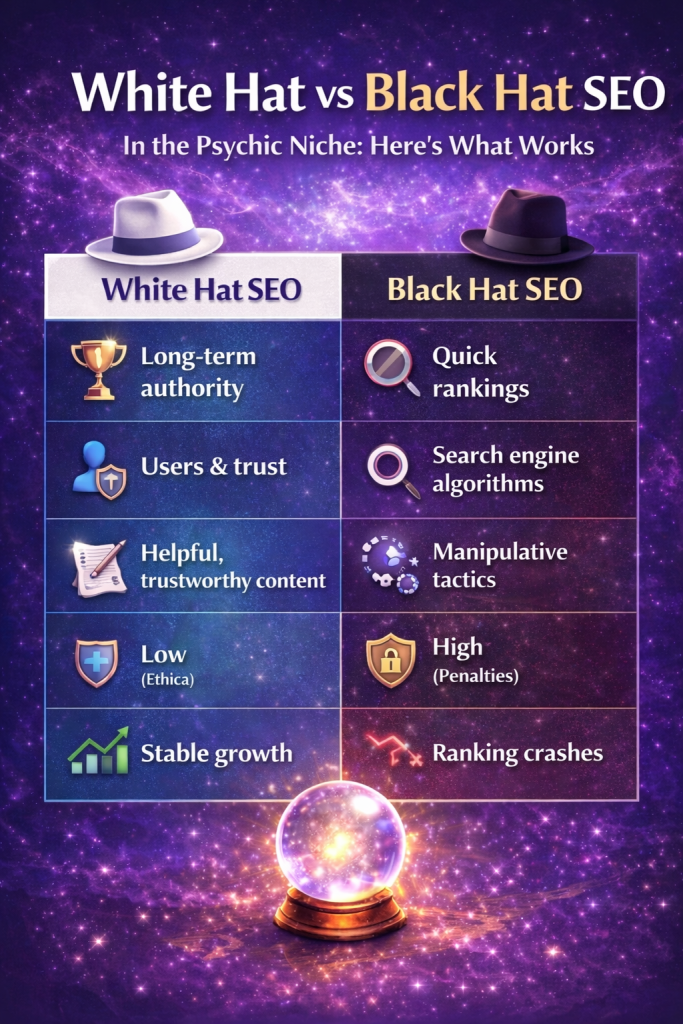
Knowing and understanding the difference between black hat and white hat SEO is not simply theoretical. In this niche, it directly determines whether a blog builds lasting authority or disappears after whatever algorithm update comes next.
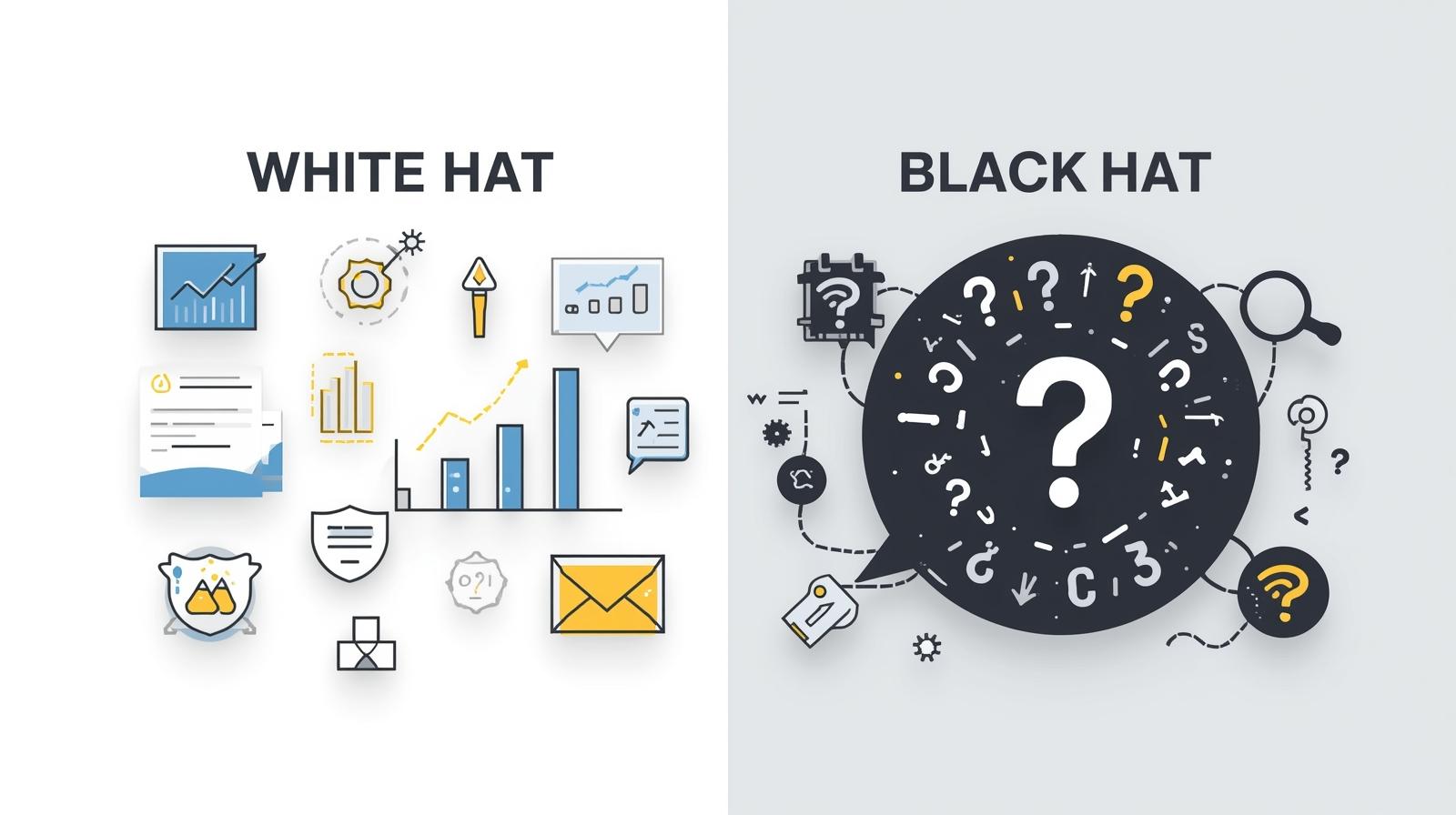
Defining Black Hat SEO
Black hat SEO is in reference to tactics that are used to manipulate search rankings instead of serving actual readers. Some of the more common black hat tactics include things like:
- Keyword stuffing
- Hidden text or cloaking
- Private blog networks (PBNs)
- Automated link building
- Fake reviews
- Scraped or spun content
Within the psychic niche, black hat tactics tend to be a little more subtle in their format, including:
- Sensational headlines promising guaranteed predictions
- Fabricated testimonials
- Aggressive “best psychic ever” comparison pages with no disclosure
- Pages targeting emotional queries with exaggerated certainty
These strategies can potentially drive short-term traffic, but they also come with structural risk.
Google’s spam policies explicitly warn against manipulative practices such as link schemes and deceptive content:
https://developers.google.com/search/docs/essentials/spam-policies
The psychic niche is emotion-filled by nature, which makes it even more vulnerable to scrutiny.
Defining White Hat SEO
White hat SEO is what aligns best with search engine guidelines and, more importantly, user intent. It emphasizes:
- Transparency
- Experience-driven content
- Clear affiliate disclosures
- Balanced tone
- Technical reliability
Instead of finding loopholes, white hat strategies focus on building authority topically. Core components of this style include:
- Comprehensive pillar guides
- Structured internal linking
- Semantic keyword coverage
- Author bios and transparency
- Evidence-backed context
White hat SEO may be slower, but it compounds over time.
The Sensitivity of the Psychic Niche
It is imperative to keep in mind that most psychic-related searches tend to reflect some type of personal vulnerability. It is not uncommon to see questions like:
- “Will my ex come back?”
- “Is he my soulmate?”
- “Is my partner cheating spiritually?”
These are far from casual searches. They are highly emotional concerns.
When black hat tactics exploit these queries with absolute promises, they create two risks. These are the ethical risks of misleading readers and the algorithmic risks of triggering quality reviews or manual penalties.
Public interest in spirituality is well documented by the Pew Research Center, which highlights ongoing engagement with belief systems: https://www.pewresearch.org/religion/
Even that type of interest does not justify manipulative positioning.
Short-Term Wins vs Long-Term Authority
Black hat SEO tends to create rapid ranking spikes, like in the following example:
A blog publishes 100 thin articles targeting variations of “free psychic reading.” It buys links from unrelated domains. Rankings climb quickly.
Three months later:
- Organic traffic drops sharply after an algorithm update.
- Pages are deindexed.
- Affiliate partnerships are terminated due to reputational risk.
White hat SEO may take longer to gain traction, but it builds structural resilience for the long-term.
Real World Scenario 1: The Comparison Page Trap
A psychic affiliate blog creates a “Top 10 Best Online Psychics” page.
Black hat version:
- The ranking is arbitrary.
- The text praising each site is identical.
- The affiliate relationship is not disclosed.
- Fake ratings are displayed.
White hat version:
- The criteria for evaluation are clear.
- The affiliate relationship is disclosed.
- Pros and cons are listed.
- Pricing comparisons are documented.
Over time, authenticity is recognized by visitors and search engines, which creates trust and loyalty.
Real World Scenario 2: Emotional Keyword Exploitation
Black hat content example:
Title: “Yes, Your Ex Will Come Back in 7 Days – Guaranteed Psychic Insight.”
White hat alternative:
Title: “Can Psychic Readings Offer Clarity After a Breakup?”
The second version:
- Describes how readings examine patterns.
- Does not make promises.
- Promotes self-reflection.
Tone is important. It is a signal of intent to readers and search engines.
Real World Scenario 3: Link Schemes vs Earned Authority
Black hat approach:
- Purchase 500 backlinks from poor-quality blogs.
- Use exact match text repeatedly.
White hat approach:
Conduct a survey based on data about the reasons people seek guidance from a psychic.
- Offer expert views to the media.
- Create educational infographics.
Authentic backlinks are based on value, not purchase.
Google’s documentation on link schemes provides clarity on prohibited tactics:
https://developers.google.com/search/docs/essentials/spam-policies/link-spam
Emotionally Driven Queries Have a Higher Risk of Manipulation
Emotionally motivated questions must be tempered.
Black hat tactics may:
- Employ fear-motivated language.
- Make promises of outcomes.
- Leverage urgency.
White hat tactics, on the other hand:
- Educate.
- Explain the limitations of psychic services.
- Focus on empowerment.
Promoting belief in psychics does not have to resort to exaggeration. Many of the audience will be seeking intuitive insights as a form of supplementary advice.
Ethical Affiliation Integration in a Highly Scrutinized Industry
It is important to handle affiliate marketing in the psychic niche very carefully. Consider when discussing monetization models that a balanced mention may include something like the following:
Some established platforms offer affiliate programs allowing bloggers to earn commissions through transparent reviews. The PsychicOz affiliate program (https://affiliates.psychicoz.com) is one such example often referenced in industry discussions. It provides commission structures for content creators who publish independent evaluations of online readings.
This approach manages to describe the program in a factual manner while avoiding a promotional tone. It also prioritizes disclosure and transparency. Clear disclosure builds credibility.
The Federal Trade Commission outlines disclosure expectations for affiliate relationships:
https://www.ftc.gov/business-guidance/resources/disclosures-101-social-media-influencers
Sustainable Content Strategies to Build Trust
White hat SEO for the psychic niche excels in:
- Long-form educational guides
- Experience-based articles
- Interviews with practitioners
- Myth-busting articles
Example:
An article such as “How Online Tarot Readings Actually Work” could feature:
- A step-by-step explanation of the process
- A description of a sample spread
- Ethical disclaimers
- A discussion of the difference between live and email sessions
Depth signals authority.
Technical Stability vs Algorithm Chasing
Black hat SEO often involves chasing algorithm loopholes.
White hat SEO focuses on:
- Fast loading speed
- Mobile optimization
- Secure HTTPS
- Structured data implementation
Google PageSpeed Insights provides actionable diagnostics:
https://pagespeed.web.dev/
Structured data guidance is available through Schema.org:
https://schema.org/docs/documents.html
Technical reliability protects rankings during updates of the algorithm.
Case Example: The Long-Term Blog
Two psychic affiliate blogs are launched at the same time.
Blog A employs black hat methods:
- Aggressive keyword stuffing
- Buying backlinks
- Faked testimonials
Blog B employs white hat methods:
- Organized pillar content
- Clear affiliate disclosure
- Neutral comparison pages
- Data-driven research
After two years:
- Blog A sees periodic ranking declines.
- Blog B sees steady growth in organic rankings and backlink quality.
Authority multiplies while manipulation fails.
What Search Engines Really Reward
Modern search algorithms increasingly evaluate:
- Topical depth
- Experience signals
- User engagement metrics
- Backlink quality
- Content clarity
They penalize:
- Thin affiliate pages
- Deceptive practices
- Overoptimized anchor text
White hat SEO naturally aligns with these reward systems.
Long-term Reputation: The Invisible Asset
In the psychic niche, reputation is not just a matter of traffic.
A blog with a good reputation could:
- Get repeat visitors
- Get asked for information by journalists
- Get direct brand mentions
- Get affiliate partners
Belief in psychics and mediums is a complex subject, with some people being very skeptical and others very committed indeed. Black hat SEO doesn’t try to overcome skeptics, but provides information that allows them to make decisions in a thoughtful way.
Reputation, however, cannot always be measured, but it can always be destroyed.
Wrapping Up
Black hat SEO in the psychic niche might work, at least in the short term, but it poses a number of problems:
- Structural problems
- Ethical problems
- Algorithmic problems
White hat SEO, on the other hand, takes longer, but it’s good for:
- Search engine rules
- Reader trust
- Affiliate best practice
In a field where gut feeling and intuition are key, credibility is the way forward. Once trust is built, it’s the most enduring ranking factor of all.