Why Pinterest Even Matters for Psychic Affiliate Traffic
Pinterest is one of the very few platforms where “free traffic” can still behave as an asset instead of a sugar rush. Most social apps are designed for velocity, which includes what is new, loud, and currently trending. Pinterest is designed for intent. People arrive looking for ideas and inspiration that can be saved, revisited, and acted upon later. That makes it unusually well-suited to affiliate marketing, especially in those niches where trust and reflection truly matter.
The psychic niche is a strong match for Pinterest for a simple reason. This reason is that much of the interest is emotional, not transactional. Users are not always searching for a product the way they might search for a toaster or blender. They are searching for something deeper, like clarity, reassurance, or a new way to think about something that feels unresolved. That is the kind of “problem” Pinterest is really built around.
Cultural context is important here as well. Pew Research Center’s survey work found that 7 in 10 US adults describe themselves as spiritual in some way, including a substantial share who are “spiritual but not religious.” Pew Research Center+1 That does not mean everyone believes in the same thing. It does mean that many people are open to practices that help them create meaning, especially when they are feeling uncertain.
This guide is practical and journalistic on how to utilize Pinterest to drive free traffic to psychic affiliate links in a way that is ethical, neutral, and effective. The goal is definitely not hype. Instead, it is a repeatable publishing system that earns clicks because it is useful.
Understanding Pinterest User Intent in the Psychic Niche
Pinterest behaves sort of like a search engine with feelings. Google searches tend to be direct and action-oriented, with the focus on things like best online tarot reading,” psychic reading price,” and “love reading tonight.” Pinterest searches can be softer: “how to trust my intuition,” “relationship clarity,” “signs I’m holding on too long,” “how to stop overthinking.” The difference will change how you build your funnel.
Pinterest Users Save Before They Click
A significant portion of Pinterest behavior is curatorial. Users build boards like “Healing,” “New Beginnings,” “Relationship Advice,” “Career Ideas,” and “Spiritual Growth.” Your pin is not only competing for a click. It’s competing to be saved.
Pins that feel safe, organized, and specific get saved. Saved pins keep circulating. That’s how “free traffic” compounds.
Pinterest Users are Often Earlier in the Journey
Many Pinterest users aren’t ready to buy anything. They’re trying to name what they’re feeling. Your content needs to meet them at that stage.
A practical way to do that in the psychic niche is to frame readings as one of several reflective tools people may explore, alongside journaling, therapy, coaching, meditation, or conversation with trusted friends. This keeps your tone neutral while still giving the reader options.
People Seek Structure Under Uncertainty
This is where psychology offers a useful, non-promotional frame. The American Psychological Association has published practical advice on dealing with uncertainty stress, emphasizing steps like focusing on what you can control and maintaining healthy routines. APA This does not validate or invalidate psychic services. It simply explains why humans search for frameworks when life feels ambiguous, which is often the moment people turn to intuitive content.
Pinterest Algorithm Thinking in 2026
There is no need to ‘hack’ Pinterest. You just need to learn to speak its language, which is based on relevance, clarity, and consistency. Pinterest’s own business guidance emphasizes filling out pin fields (such as titles and descriptions) and using relevant keywords to help Pinterest understand your content. To put this in Pinterest speak, “Pinterest cannot recommend what it cannot categorize.”
Fresh Pins Matter
Fresh pins are new creative assets (new image files), even if they link to the same URL. You can publish multiple pins to one article, each with a different headline angle.
Think of each pin as a different doorway into the same room.
Consistency Beats Bursts
Pinterest usually rewards steady publishing. Two to five fresh pins per day, consistently, is usually more effective than posting 50 pins on a weekend and disappearing.
Relevance is Your Real Growth Lever
A pin can “win” with modest engagement if it cleanly matches search intent. Viral isn’t the goal. The intent is.
Setting Up a Pinterest Account for Psychic Affiliate Success
Before you start creating pins, set up an account just as you would a publication, not like a personal scrapbook. You do this by:
Using a Business Account
A business account gives you analytics and signals to Pinterest that you’re publishing content with intent. It also helps with credibility when people click through.
Writing a Profile that Signals Neutrality and Usefulness
Your bio should answer two questions:
- What do you help with?
- How do you approach it?
Examples of neutral, trust-forward positioning:
- Guides for intuitive clarity and life transitions
- Relationship reflection tools and spiritual self-inquiry
- Practical explanations of psychic readings and related practices
Avoid absolutes. Avoid predictions. Avoid “life-changing” language.
Build Boards like a Newsroom Builds Sections
Boards should be specific and keyword-aligned.
Good board examples for this niche:
- Online Psychic Reading Explained
- Relationship Clarity and Intuition
- Tarot and Symbolic Tools
- Trusting Your Intuition
- Moving On and Emotional Healing
- Career Crossroads and Decision Clarity
The board title is not just decoration. It’s part of Pinterest SEO.
Keyword Strategy for Psychic Content on Pinterest
Pinterest keywords are less about ranking and more about matching. Your job is to make it very easy for Pinterest to know what your pin is all about.
How to Find Keywords:
Use Pinterest search autosuggest:
- Type “psychic reading” and note the suggested phrases.
- Type “intuition” and note modifiers.
- Type “relationship clarity” and look for recurring patterns.
Then Build a Keyword Bank:
Tier 1: Core Topics
psychic reading, tarot reading, intuition, spiritual guidance
Tier 2: Intent Modifiers
for beginners, first time, what to expect, how to choose, red flags
Tier 3: Emotional Long-tail Phrases
feeling stuck, breakup clarity, overthinking, trust yourself, new beginning
Where to Place Keywords
Pin title: one primary phrase
Pin description: natural language that includes 2–4 related phrases
Board name: matches the theme
On-image text overlay: mirrors the title
Pinterest’s business guidance recommends filling in all pin fields, including title and description, to help contextualize content.
Designing Pins That Get Clicks
Within the psychic niche, design is not about looking mystical. It is all about looking (and being) trustworthy.
Visual Components
- Text-forward pins
- Clear headline
- High contrast readability
- Simple background or calm imagery
- Minimal clutter
Pinterest’s creative best practices emphasize clear branding and design that support the message, which applies even if you’re not running ads.
Well-Performing Headline Formulas
- “How to” clarity
How to Get Clarity When You’re Overthinking
- “What to expect” reassurance
What to Expect in an Online Psychic Reading
- “Checklist” structure
7 Questions to Ask for Relationship Clarity
- “Myth vs reality” skepticism-friendly
Psychic Readings: Myth vs Reality
- “Gentle authority” framing
A Calm Guide to Trusting Your Intuition
Avoid Sensational Headlines
Instead of: Your Psychic Will Tell You Exactly What Happens Next
Use: How People Use Psychic Readings for Reflection and Perspective
This keeps your content persuasive without being exaggerated. It also fits a USA Today–style tone that is informative, neutral, and reader-first.
Content Types to Focus On for Affiliate Traffic
There are three main types of high-converting Pinterest traffic, and this is usually the content that reduces uncertainty. We have shared some examples here:
Explainers
Explainers attract first-timers, and first-timers are often the most responsive to affiliates when they feel safe.
Examples:
- What happens in a session
- How pricing works
- How to choose a reader
- What questions to ask
Checklists and Frameworks
Pinterest users love structure. Give them structure.
Examples:
- A “first reading prep checklist.”
- A “red flags to avoid” list
- A “questions to ask” framework for relationships or a career
Prompt-based Content
Prompt pins get saved often because people want to revisit them.
Examples:
- 5 prompts to clarify what you actually want
- 7 prompts for relationship clarity
- 10 prompts for decision-making under stress
This is where a subtle persuasive angle works well: you can suggest that some people find it helpful to combine journaling prompts with a conversation-based tool (like a reading) when they want another perspective. You’re not promising outcomes. You’re describing a reflective workflow.
Four Pinterest Pin Examples with Copy You Can Use
The following examples are created for clarity and neutrality. Each one includes pin text, description style, and the best destination page type.
Example 1: First-time Reading Explainer Pin
Pin text overlay: What to Expect in an Online Psychic Reading
Pin title: What to Expect in an Online Psychic Reading (Beginner Guide)
Pin description: New to online psychic readings? This calm guide covers formats, what to ask, and how to choose a reader responsibly.
Best destination: A 1,500–2,500-word explainer article with headings, FAQs, and a resources section.
Why it works: It lowers anxiety. It matches beginner intent. It earns savings.
Example 2: Relationship Clarity Checklist Pin
Pin text overlay: 7 Questions for Relationship Clarity
Pin title: 7 Questions for Relationship Clarity When You’re Stuck
Pin description: Feeling uncertain about a relationship? Try these questions to reflect, notice patterns, and decide your next step calmly.
Best destination: A checklist-style post with prompts, examples, and optional resources.
Why it works: It feels practical, not mystical. It’s easy to save.
Example 3: Career Crossroads Framework Pin
Pin text overlay: Stuck in Your Career? Start Here
Pin title: Career Uncertainty: A Simple Clarity Framework
Pin description: A practical guide for when you don’t know what’s next: values, constraints, small experiments, and reflection prompts.
Best destination: A framework article with a printable worksheet.
Why it works: It targets a major life stressor without promising a miracle.
Example 4: Skeptic-friendly Myth vs Reality Pin
Pin text overlay: Psychic Readings: Myth vs Reality
Pin title: Psychic Readings: Myth vs Reality (A Skeptic-Friendly Guide)
Pin description: Not sure you believe? Here’s how to evaluate readings responsibly, spot red flags, and keep expectations grounded.
Best destination: A consumer-literacy article with red flags and ethical boundaries.
Why it works: It widens your audience and increases trust.
Where Affiliate Links Fit on Pinterest Without Eroding Trust
In this specific niche, the cleanest path is typically: Pin → Educational article → Optional affiliate link
Why not a direct link?
Direct-link affiliate pins can feel really abrupt because the user has not really received any context yet. Many Pinterest users are still deciding what they think about the topic overall. This means sending them straight to an offer can actually lower clicks and increase bounce rates.
Use the “resources section” method
A resources section near the middle-to-late part of your article works well. Try:
- Tools for reflection (journaling prompts, templates, meditation links)
- How to choose a reader responsibly
- Optional platforms to explore (with disclosure)
This placement helps the reader feel guided, not sold to.
Mid-article contextual mention
Within the body of an educational article, it’s common to reference affiliate programs as examples of marketplaces where readers can explore services if they choose to. In that context, a neutral mention of the PsychicOz affiliate program at affiliates.psychicoz.com can appear as one option among others, described simply as an affiliate program connected to an online platform that links users with independent psychics, without implying guarantees or outcomes. That approach is both transparent and consistent with a journalistic tone.
Building a Pinterest-to-Article Funnel that Converts
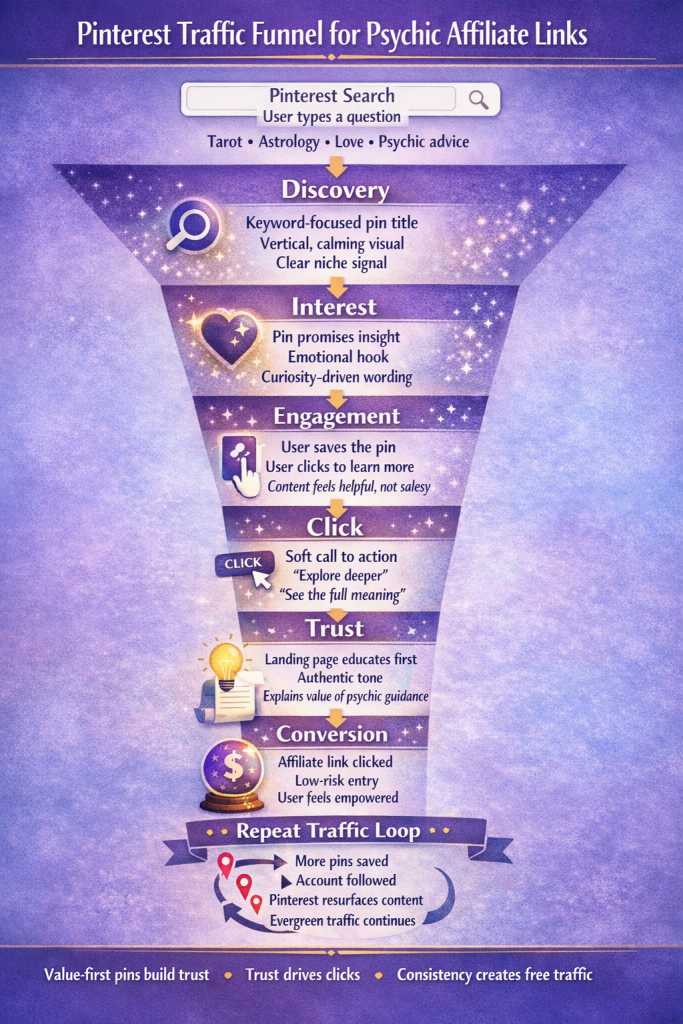
Pinterest traffic converts when your pin, as well as your page feel like the same promise:
One pin, one promise
Each pin should focus on one question:
- What should I expect?
- How do I choose?
- What should I ask?
- What are red flags?
- How do I find clarity?
If you try to cram everything into one pin, you end up with a vague headline and a low click rate.
Match the pin headline to the H2 on the page
If your pin says “7 Questions for Relationship Clarity,” the article should have a section with that exact heading and those questions immediately visible. Pinterest users expect fast payoff.
Use a “calm onboarding” opening
Pinterest readers often arrive in an emotionally activated state. A short opening that normalizes their feeling and promises structure can reduce bounce:
If you’re feeling stuck, you’re not alone. This guide offers a simple set of questions to help you reflect and choose your next step.
Build internal links like a mini-series
Inside your articles, link to related posts:
- First-time guide → red flags guide
- Relationship clarity → questions to ask guide
- Career framework → intuition vs anxiety guide
This increases session depth and turns Pinterest clicks into repeat readers.
Pinterest SEO for Psychic Affiliates
Pinterest SEO is pretty straightforward if you treat it as if it were publishing.
Titles and descriptions should be written for humans first
Use natural language, clear meaning, and one primary keyword phrase.
Boards are long-term assets
Don’t create 40 vague boards. Create 8–12 tight boards with strong naming.
Refresh old content with new pin creatives
If an article performs, create 10 new pins for it over time:
- Different headlines
- Different layout
- Different image
- Different keyword angle
Pinterest’s own guidance emphasizes fully completing pin fields and using keywords to contextualize content, both of which support this refresh approach. Pinterest
Authority and Trust Signals That Matter in This Niche
If you desire Pinterest traffic to convert in a sensitive niche, credibility has to be built into the content. This is accomplished by:
Using neutral, authoritative references for context
When discussing why people seek guidance or why spirituality is mainstream, cite research rather than vibes. Pew’s spirituality research provides a credible context about how widespread spiritual identity is in the U.S. Pew Research Center+1
When discussing uncertainty and stress, APA’s “stress of uncertainty” guidance gives you practical framing that doesn’t require metaphysical claims. APA
Think like a publisher, not a promoter
Harvard Business Review’s perspective that content marketers need to act like publishers aligns with Pinterest’s success: consistent editorial output, audience retention, and long-term value. Harvard Business Review
That’s also the best way to avoid looking promotional: publish like you’re running a helpful section in a newsroom.
Common Pinterest Mistakes for New Psychic Affiliates
Mistake 1: Designing for “mystical” instead of “clear.”
A pin should read instantly. If it looks like album art with no message, it won’t get clicks.
Mistake 2: Keyword stuffing
Pinterest is not impressed by a paragraph of keywords. Write one clean description.
Mistake 3: Pinning offers before building trust
If your first pins link to offers, Pinterest users may bounce, and Pinterest may limit distribution.
Mistake 4: Creating too many boards
Too many boards dilute topical authority. Better: fewer boards, stronger themes, more consistent pinning.
Mistake 5: Treating Pinterest like Instagram
Pinterest is search and discovery. Success is measured in months, not hours.
A 30-Day Pinterest Plan
This is a realistic plan that does not require a separate design team or continual posting.
Week 1: Build the foundation
- Set up a business profile
- Create 8–12 keyword-rich boards
- Write board descriptions with 2–3 natural phrases each
- Add a clear bio and consistent visual identity
Week 2: Create content and creatives
- Publish or polish 2–3 cornerstone articles:
- What to expect in an online reading
- How to choose a reader responsibly (red flags included)
- Relationship clarity questions (or career clarity framework)
Design 20–30 fresh pins:
- 10 pins to “what to expect”
- 10 pins to “how to choose.”
- 10 pins to your emotional-intent post
Week 3: Publish consistently and observe
- Post 2–5 fresh pins per day
- Track impressions, saves, and outbound clicks
- Identify what headline style performs best:
- What to expect vs checklist vs myth/reality
Week 4: Optimize and scale
- Create 10 additional pins for your best-performing URL
- Rewrite pin titles using the exact phrases driving impressions
- Add a new related article and build internal links
- Update old articles with clearer H2s that match pin headlines
Realistic expectation:
Pinterest often takes several weeks to “understand” a new account. Early impressions may be modest. That’s normal. The compounding shows up later.
Measure Results and Scale What Works
Track metrics that reflect your intent, not vanity. Keep the following in mind.
Pinterest Metrics:
- Impressions (distribution)
- Saves (future distribution)
- Outbound Clicks (traffic)
Website Metrics:
- Time on page
- Scroll depth
- Affiliate link clicks
- Email signups (if you use a lead magnet)
Scaling Rule:
Scale winners by making more creatives, not by randomly making more content. If one article brings consistent clicks, build a pin portfolio around it.
Why Pinterest is Still One of the Best Free Traffic Sources
Pinterest still remains one of the strongest, free traffic sources for psychic affiliate marketing because it rewards those who use clarity, usefulness, and long-term discovery. Psychic content fits the platform when it is framed in a responsible manner. You need to offer reflective guidance, not guarantees.
If you can publish as if you are a calm, practical resource with built-in keyword-aligned boards and continually creating fresh pins, then you will route traffic into educational articles before the related affiliate links. This allows Pinterest to become a steady source of visitors who are genuinely interested in learning and exploring at their own pace.