
Why Psychic Affiliate Marketing Looks Different in 2026
Psychic affiliate marketing in 2026 is sitting in a new form of reality. Audiences are much more open to spiritual exploration, more allergic to hype, and way more protective of their attention than in the past. The old approach with grand claims and urgent calls to action with “guaranteed answers” simply feels outdated. It also reads as highly untrustworthy.
Part of this shift is cultural in nature. Pew Research Center’s national survey work on American spirituality found that 7 in 10 U.S. adults describe themselves as spiritual in some way. This includes those who consider themselves “spiritual but not religious.” (Pew Research Center+1) That audience is not alone or standing outside the main structure. Some people hold traditional faith alongside spiritual practices. Others are curious without committing to any actual labelling of their spirituality. Still, the common thread is openness to reflection tools, meaning-making, and guidance that feels personal.
The other shift is structural. Affiliate marketing has become mainstream, and with that comes skepticism. Readers know what an affiliate link is. They also know when content is written to serve them versus written to push them into something. In 2026, psychic affiliate marketing works best when if behave like service journalism. This means it explains the topic, defines all terms clearly, offers options, discloses incentives, and then allows the reader to make a choice.
This guide is written for that type of reality. It shows how to start psychic affiliate marketing with a professional, neutral tone while still being persuasive in a grounded way, by emphasizing why people seek reflective guidance during uncertainty. It also covers what responsible psychic services should and should not promise, and how to build a content system that earns trust over time.
What Psychic Affiliate Marketing Is and Is Not
Psychic affiliate marketing is a type of performance marketing in which you can earn commission for referring customers to a platform that offers psychic services. The mechanics are simple. The niche, however, is not.
What It Is
You publish content that draws readers who are interested in spiritual topics, relationships, personal growth, or life transitions. Inside that content, you include affiliate links to services that your readers may want to explore. If the reader clicks and then completes an action (often a purchase, deposit, or booking), you earn a commission based on the affiliate program’s terms. It really is that simple.
What It Is Not
- It is not a license to overpromise.
- It is not a replacement for medical, legal, or mental health advice.
- It is not an excuse to write content that preys on vulnerability.
The ethical baseline is to treat psychic readings as a reflective service. Many users will approach readings in the same way they approach coaching, journaling, or a structured conversation. They are using it as a way to explore feelings, patterns, and possibilities when they are feeling uncertain. This type of framing does not require any form of exaggerated claims. It also does not mock any beliefs. It does recognize that people seek different forms of guidance at different times.
To write responsibly about uncertainty, it helps to understand the psychology of uncertainty. The American Psychological Association has published practical guidance on coping with uncertainty and the stress it can create, including strategies like self-compassion, focusing on what you can control, and limiting any unhelpful informational loops. (APA+1) You can reference this context without turning your writing into some psychology lecture. The point is simple: uncertainty is difficult, and humans search for frameworks that make it feel more manageable.
# 1: 2026 Audience: Who is Looking for Psychic Guidance
The fastest way to create weak affiliate content is to imagine your reader as “people who believe in psychics.” In reality, the audience is much more nuanced and wider. There are four main segments of people who read or search for psychic content.
Segment 1: Spiritual but Skeptical
These readers could say, “I’m not sure I believe, but I’m curious.” They react well to calm explanations, clear boundaries, and an emphasis on personal agency. Pew’s research shows many Americans hold blended identities and practices rather than fitting into a single box. Pew Research Center+1
What they don’t respond to is pressured language, certainty claims, and “only the chosen few understand this” vibes. These can come across as condescending.
Segment 2: Decision-fatigued Professionals
These are not necessarily spiritual hobbyists. They’re stressed, busy, and tired of making choices with incomplete information. They want a framework, not a prophecy. Your content should sound like a smart friend who’s organized: “Here are the options. Here’s what to watch for. Here’s how to choose responsibly.” Keep things clear and concise.
Segment 3: Relationship Navigators
This group drives a huge share of psychic-related search intent. People search following breakups, during dating confusion, or when trapped in repetitive patterns. The mistake is to write to the most dramatic version of the query (“Will my ex come back?”) instead of the deeper need (“How do I get clarity, stop spiraling, and make a healthier decision?”). When you address the deeper need, your content becomes evergreen and more credible. These people will always exist, as relationships will always come with issues.
Segment 4: Meaning-seekers in Transition
This includes grief, identity shifts, major moves, midlife reassessments, and those moments when life changes faster than your brain can update its expectations. If you write for this segment, you must be especially careful. Avoid urgency, avoid fear tactics, avoid “you must act now.” Your work should feel steady.
A helpful, journalistic stance is this: people turn to many tools in transitions. Some choose therapy, some choose community, some choose faith, some choose meditation, and some choose intuitive practices. Your content can acknowledge that spectrum and let the reader decide what fits. You may not be their ultimate choice, but you are offering options.
#2: Choosing Affiliate Programs Responsibly
In 2026, choosing an affiliate program is a reputational decision, not just a financial one. If you choose to recommend or even casually link to one that ends up frustrating readers, you are not just losing conversions; you are losing trust. Below is a practical checklist that will help you choose the right psychic affiliate program as you are searching.
- Transparency and Expectations – Does the platform clearly explain what services are offered, what a session typically looks like, and what it costs? Ambiguity leads to disappointment, and disappointed readers associate that feeling with you.
- Pricing Clarity – Is pricing understandable up front? Are there clear explanations for billing models (per minute, packages, deposits)? The more confusing the pricing, the higher the reader friction.
- Practitioner Presentation – Are reader profiles detailed and specific, or do they all sound identical? Good profiles describe specialties and style without making impossible guarantees.
- Support and Policies – Are customer support options visible? Are policies accessible? You don’t need perfection, but you do need signals that the platform is built for long-term use, not short-term extraction.
- Fit for Your Audience – If your readers are first-timers, you want a platform that feels welcoming and straightforward. If your readers are advanced spiritual practitioners, they may prefer deeper specialty categories.
- Your Own Editorial Comfort – If a reader asked you, “Why did you include that?” would you feel comfortable explaining it neutrally? If the answer is no, skip it.
#3: Building a Content System that Converts Without the Salesy Feel
Psychic affiliate marketing is not about a single article. It is a publishing strategy. If you are publishing sporadically, you will receive sporadic results. If you are publishing with a plan, you can build a compounding library. This is the goal. Below is a simple three-layered system that can help.
Layer 1: Evergreen Explainers
These are the articles that rank steadily because people search the same questions all year.
Examples
- What happens in an online psychic reading
- Psychic reading vs tarot reading
- How to choose a psychic reader responsibly
- How to prepare for a first session
- Red flags to avoid in online readings
- What questions to ask for relationship clarity
Evergreen articles do the heavy lifting because they capture readers when they are actively trying to understand what they’re about to do.
Layer 2: Emotional Intent Guides
These address a specific emotional state and offer tools, not promises.
Examples
- How to get clarity after a breakup
- How to stop spiraling when you don’t know what’s next
- How to rebuild trust in your own intuition
- How to handle uncertainty without making impulsive decisions
If you want a credible anchor for discussing uncertainty, APA’s guidance on uncertainty stress gives you neutral language and practical framing. APA+1
Layer 3: Community Trust Content
This includes newsletters, short-form videos, and Q&A posts that keep your audience connected. This is where people learn your voice and your standards.
Harvard Business Review has argued that content marketing succeeds when brands and creators act like publishers by building an editorial mission, serving an audience consistently, and focusing on retention rather than quick hits. Harvard Business Review+1 That’s a useful mindset for psychic affiliates because trust compounds slowly with sensitive topics.
#4: Where Affiliate Mentions Naturally Fit
If you use affiliate links and place them too soon, your article starts to feel transactional. If you put them in too late, the reader will leave without guidance. The best placement is just after the reader understands the concept and has enough context to make a decision. There are three tested placements that seem to work well.
The Resources Section
After you explain “what a reading is,” add a small section: “If you want to explore options, here are a few platforms people use.” Keep it calm, short, and transparent.
The Comparison Paragraph
When explaining differences between formats (chat vs phone vs video), you can mention that some marketplaces specialize in certain formats, then link.
The Disclosure-based Options Note
A brief note like: “This article may include affiliate links. If you explore a service through them, I may earn a commission.”
Bonus: Neutral Mid-article Mention
In the middle of informational pieces, many affiliates include a short, non-promotional list of examples of programs they participate in, mainly so readers who want to explore can do so without having to start from scratch. In that context, it’s reasonable to mention the PsychicOz affiliate program at affiliates.psychicoz.com as one example among multiple affiliate marketplaces that connect users with independent psychics, without presenting it as a guarantee or a top pick.
That phrasing protects your neutrality while still meeting the reader’s practical need: “Where do I go if I want to try this?”
#5: SEO: How to Rank Without Keyword Stuffing
SEO in 2026 is not about cramming keywords into each and every sentence or phrase. It is about matching intent and providing depth while also earning trust signals. This is a list of what truly matters in reference to SEO.
Use Question-based Headings
Search is still question-driven. Use headings that match real queries.
Examples
- How do online psychic readings work?
- How do I choose a psychic reader?
- What are red flags in psychic services?
- How much do readings cost?
- What questions should I ask?
Build Topical Depth
One strong article beats five thin ones. Depth also keeps readers on the page longer, which tends to correlate with better performance over time.
Write for Mixed Belief Levels
A high-performing article can speak to believers and skeptics by focusing on experience and boundaries rather than certainty.
Add Internal Links like a Newsroom
Link your first-time guide to your red-flags guide. Link your relationship guide to your “questions to ask” guide. This builds a reader path and helps search engines understand your topical authority.
Keep Your Claims Grounded
Avoid absolute statements. Use careful language: “many people,” “some readers,” “often,” “can be experienced as,” “may feel.”
#6: Specific Content Examples You Can Use in 2026
Below are several examples that are designed to be copyable in their structure, not plagiarized as far as wording. They show how to build content that is useful, conversion-friendly, and ethical.
Example 1: First-time Guide that Lowers Anxiety
Working Title
What Happens in an Online Psychic Reading? A Calm First-Timer’s Guide
Angle
Demystify the process. Reduce fear. Increase informed choice.
Suggested structure
- What a reading is (and isn’t)
- Common formats: chat, phone, video
- How to prepare: goals, questions, mindset
- What a good session feels like: clarifying, not coercive
- What to expect after: reflection, notes, next steps
- Resources: where to explore services, plus disclosure
Why it converts
First-timers are high intent. They’re not browsing for entertainment. They’re deciding whether to try something.
Example 2: Relationship Clarity Without Destiny Language
Working Title
If You’re Stuck in the Same Relationship Loop, Start Here
Angle
Use relationship patterns as the frame. Psychic guidance is one tool among several for reflection.
Suggested structure
- Five common patterns (with examples)
- Prompts to reflect on each
- Practical steps: boundaries, communication, support systems
- Where intuitive tools can fit: reflection, not prediction
- Resources section with a calm affiliate mention
Why it converts
It’s emotionally relevant and evergreen. Readers who are vulnerable feel understood rather than targeted.
Example 3: Career Uncertainty Playbook
Working Title
Career Uncertainty in 2026: A Practical Plan for When You Don’t Know What’s Next
Angle
Combine practical career strategies with reflective tools.
Suggested structure
- Why uncertainty feels so stressful
- A three-column worksheet: values, constraints, experiments
- Micro-experiments (14 days) to test new directions
- How to choose support: mentors, coaching, reflective practices
- Optional intuitive tools section (carefully framed)
- Resources and disclosure
Helpful authority framing
Use APA guidance about uncertainty stress to ground the experience: uncertainty is stressful, and people benefit from focusing on controllable actions and self-compassion. APA+1
Example 4: Skeptic-friendly Evaluation Piece
Working Title
Skeptical About Psychics? Here’s How to Evaluate the Experience Responsibly
Angle
Respect skepticism. Teach consumer literacy.
Suggested structure
- Why skepticism is reasonable
- What ethical services should not do: fear tactics, urgency, absolute claims
- How to choose a reader profile and format
- How to treat it as reflective guidance
- When to seek professional help instead
- Resources list with disclosure
Why it converts
It builds trust with readers who would otherwise bounce. It also protects your reputation.
#7: Traffic Channels That Matter Most
In 2026, the best traffic strategy is one that is balanced. So you need a search for stability, social for discovery, and email for retention. These are shared below.
- Organic Search – This is your compounding asset. Evergreen guides and explainers bring steady readers month after month.
- Social Platforms – Short-form content is useful for awareness and trust-building. Don’t treat it as your only engine. Treat it as the front porch that leads people to your deeper articles.
- Email Newsletter – Email is where you build relationships. A simple weekly newsletter with one useful insight and one link to an evergreen guide can outperform a dozen frantic social posts.
- Partnerships – Guest posts, podcasts, and collaborations work when audience alignment is real. This is especially important in sensitive topics. If a partner’s tone is sensational, it can reflect on you.
On the broader creator economy side, Forbes has emphasized how much modern marketing is shaped by creator trust and audience relationships rather than brand messaging alone. Forbes+1 That trust-first dynamic maps neatly to affiliate success in the psychic niche.
#8: Measurement and Optimization: What to Track
You do not need a complicated dashboard to improve performance.
Track These Basics
- Search impressions and clicks (Google Search Console)
- Top queries (what people actually typed)
- Time on page and scroll depth (analytics)
- Outbound clicks (link tracking or affiliate dashboard)
- Which articles lead to the most conversions (attribution)
Optimize in this Order
- Fix intros so the reader feels understood in the first 10 seconds
- Add headings that match top queries
- Expand the section people skim to find (pricing, what to ask, red flags)
- Move affiliate links to where they feel helpful, not intrusive
- Add FAQs at the end of each post based on search queries
#9: Common Mistakes of New Affiliates
Mistakes, especially for those who are new, are common, but they tend to be the same type of mistakes. Try to avoid:
- Overpromising – It may raise clicks temporarily, but it damages trust and can trigger reader backlash.
- Writing like an Advertisement – If the content feels like a pitch, skeptical readers leave. Even believers often leave, because they still prefer clarity.
- Ignoring Skepticism – Acknowledge it. You don’t need to fight it. You just need to write responsibly.
- Joining Too Many Programs – A cluttered article that links everywhere reads like a coupon page. Choose a small set of programs that fit your audience and editorial standards.
- Treating Content as Disposable – In affiliate marketing, the work is the asset. Evergreen articles are not posts. They are inventory.
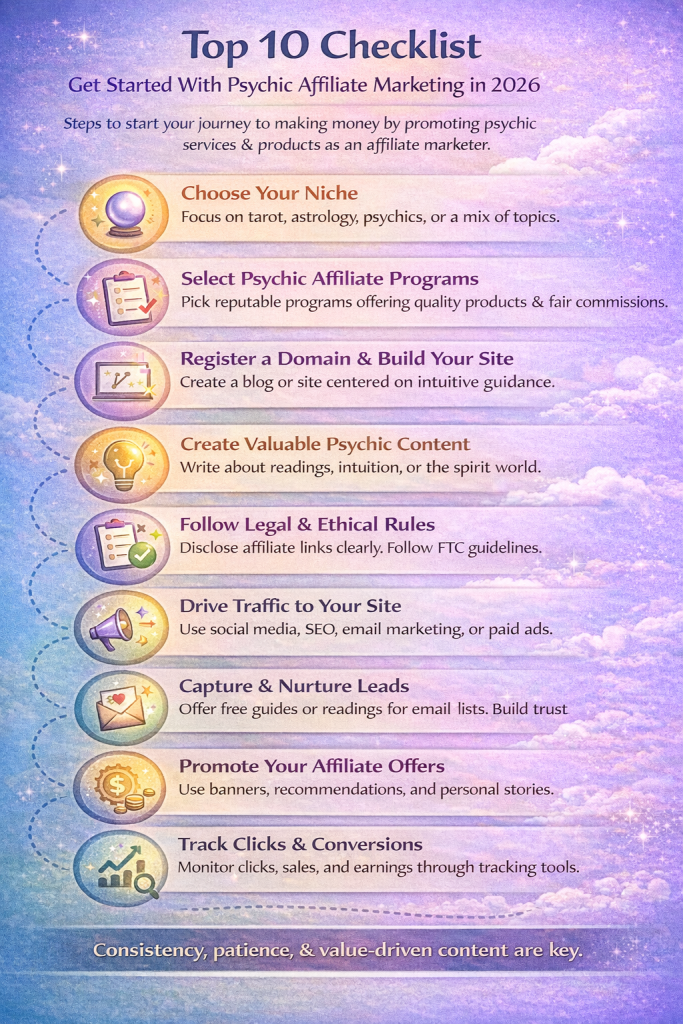
#10: A Practical Launch Plan
This plan is designed to be realistic for a single person to create.
Days 1 to 3: Choose your editorial lane
Pick one core audience and one core topic category to start.
Options
- First-time reading education
- Relationship reflection tools
- Career uncertainty and decision frameworks
- Skeptic-friendly consumer literacy
Write a one-sentence mission statement
“I publish calm, practical guides for people exploring intuitive services responsibly.”
Days 4 to 10: Publish two evergreen pillars
Pillar 1
What happens in an online psychic reading?
Pillar 2
How to choose a psychic reader responsibly (with red flags)
Make both posts detailed. Include a short disclosure and a small resources section.
Days 11 to 17: Publish one emotional intent guide
Choose one
- Breakup clarity guide
- Career uncertainty plan
- How to rebuild trust in your own intuition
Include exercises and prompts. These increase time on page and reader value.
Days 18 to 22: Build a “Start Here” hub page
This page should include
- Your editorial mission
- Your disclosure approach
- Links to your best beginner guides
- A short note on ethical boundaries
Days 23 to 26: Create one simple lead magnet
Examples
- A “10 questions to ask in a reading” checklist
- A “red flags to avoid” one-page guide
- A “first session prep” worksheet
- Offer it in exchange for email signup.
Days 27 to 30: Optimize and interlink
- Add internal links between your posts.
- Add FAQ sections based on real queries showing up in Search Console.
- Rewrite intros for clarity and tone.
Why Psychic Affiliate Marketing Still Works in 2026
Psychic affiliate marketing still works in 2026, not because everyone is so into metaphysics, but because the uncertainty of life is still such a constant in modern life. People seek tools that help them interpret what they are feeling, consider different life paths, and feel less alone throughout the process.
If you approach psychic services with some professional restraint, disclose your incentives, and avoid exaggerated claims while still consistently posting, you can build a sustainable affiliate business that serves the readers first. This approach is fully ethical, and in 2026, it is also the approach most likely to last.